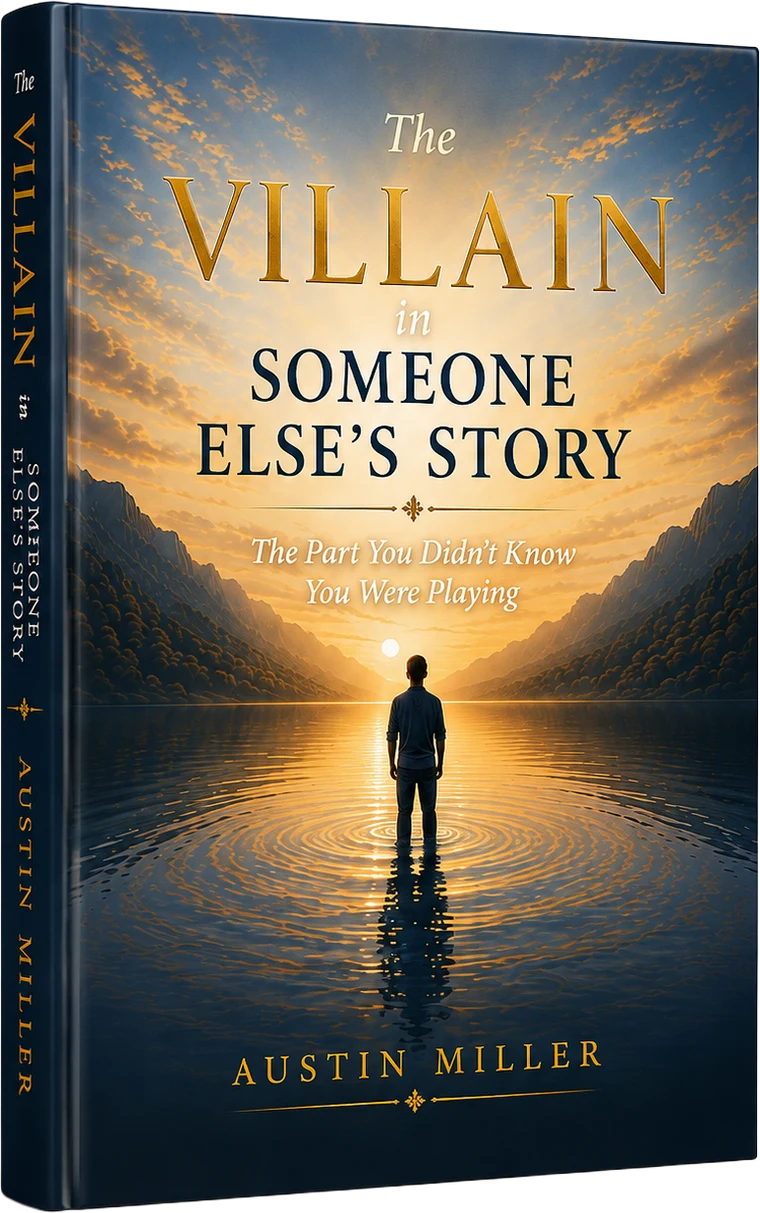
TheVILLAINin Someone Else's Story
The Part You Didn't Know You Were Playing
By Austin Miller
In Publisher Review 250 pages 10 chapters in three parts
The book is the first step into the idea. The clearest way to join it is to become an early reader.
Preorder coming soon at
"You don't get your life back by proving them wrong. You get it back by becoming someone the story can no longer hold."
From Chapter Seven
What early readers are saying.
I picked it up expecting a book about being misunderstood. What I got was a mirror. The chapter on the stories we tell about other people stopped me cold, in the best way.
Rachel M.
Early manuscript reader
Austin writes about the hardest parts of being human without flinching and without preaching. Before I finished the manuscript I had already told three people they need to read it when it comes out.
David T.
Early manuscript reader
The science made me understand my own memory differently. The story made me call someone I had written off years ago. Few books do either. This one did both.
Jennifer L.
Early manuscript reader
What this book is.
The Villain in Someone Else's Story sits at the intersection of psychology, neuroscience, and deeply personal human experience. It explores one of the most universal and least examined dynamics in human relationships: the way stories form around people, how those stories travel and harden into something that feels like fact, and what a person can actually do when the narrative about them no longer resembles who they are.
It is not a victim's manifesto. It is not a self-help book that promises easy redemption. It is an honest, research-grounded, and at times uncomfortably personal examination of how lenses shape stories, how stories spread through communities and institutions, and how character, built consistently, over time, in ordinary moments, is the only thing that eventually makes a damaging narrative unsustainable.
The science explains the mechanism. The story shows the cost. The framework gives the reader a path forward.
You'll feel this book if you've ever lived this.
If you've been wrongly portrayed.
You know a story has formed about you that doesn't capture who you are or what actually happened. You're not looking to deny your failures. You're looking for a framework to understand how a story that started in reality became something you barely recognize.
If you've owned what you did and are still being defined by what you didn't.
You've made real mistakes and taken accountability for them. You're trying to reconstruct something genuine while a distorted version of you continues to travel. This book holds you accountable and holds space for you at the same time.
If you've formed an opinion about someone and you're willing to question it.
You're carrying a confident narrative about another person. You're willing, even slightly, to examine whether you have the full picture. This may be the most important reader the book has. Your willingness to look at your own lens is where the most significant healing happens.
If you want to understand your lens before it causes damage.
You haven't been through anything dramatic. You want to understand the perceptual filters you carry well enough that you never become the person who, without meaning to, casts someone else as the villain in a story that isn't quite true.
Ten chapters. Three movements.
How You Got Here
How perception is built and why two people standing in the same moment can walk away with two different truths. The neuroscience and psychology of the lens, the brain that quietly rewrites history to protect us, and the way a story finds its first audience.
- Chapter 1: The Day the Story Changed
- Chapter 2: The Brain That Rewrites History
- Chapter 3: How Stories Travel
What You Did With It
The harder middle of the book. Why people hurt people, often without meaning to. The mirror story we avoid looking into. The Four P's behind almost every wound we hand each other. And the small, honest question of what you can actually control once the story is already moving.
- Chapter 4: The Mirror You've Been Avoiding
- Chapter 5: Hurt People and the Harm They Spread
- Chapter 6: What You Can Actually Control
What Comes Next
Rebuilding a life while a story you cannot fully correct continues to travel. The people who stay and the people who leave. Forgiving what you cannot fix. And the quiet, durable thing that remains when the noise finally moves on to someone else.
- Chapter 7: Rebuilding When the Story Is Still Circulating
- Chapter 8: The People Who Stay and the People Who Leave
- Chapter 9: Forgiving What You Cannot Fix
- Chapter 10: What Remains
Lines worth carrying.
"You do not remember what happened. You remember the last time you remembered it.
From Chapter Two
"Accountability taken is not always accountability received.
From Chapter Four
"Shame is the thing that makes your past available as a weapon.
From Chapter Seven
"Pain explains. It does not excuse. But explanation is where the healing begins.
From Chapter One
"The villain in someone else's story. The author of your own. Keep writing.
From Chapter Ten
The book gives you the lens. The app helps you use it.
A private space for readers, built around five practices from the book. Everything lives on your device. An account is an optional backup, never a requirement.
The Lens Profile. See the lens you are looking through.
The Responsibility Audit. Walk through a conflict one step at a time.
The Four P's. Find where a story hardened into a role.
Say It Here First. Write the hard thing before saying it anywhere else.
The Private Record. Keep what you find. Locked, and only yours.

Reading on a computer? Scan with your phone to open the app.
A few quick questions.
Become an early reader.
You've read what the book is. The next step is to read it. Join the early readers and get the introduction first, plus chapters as they're ready.
- The introduction, before anyone else
- Exclusive chapters as they're ready
- Private notes from Austin along the way
“Before I finished the manuscript I had already told three people they need to read it when it comes out.”
2,483 readers have already joined.
One thoughtful email at a time. Unsubscribe whenever you like.